
Radon Fan Replacement and Radon System Repair
The fan went quiet, got loud, or the gauge on the pipe went flat. We fix the system you already have, whoever put it in.
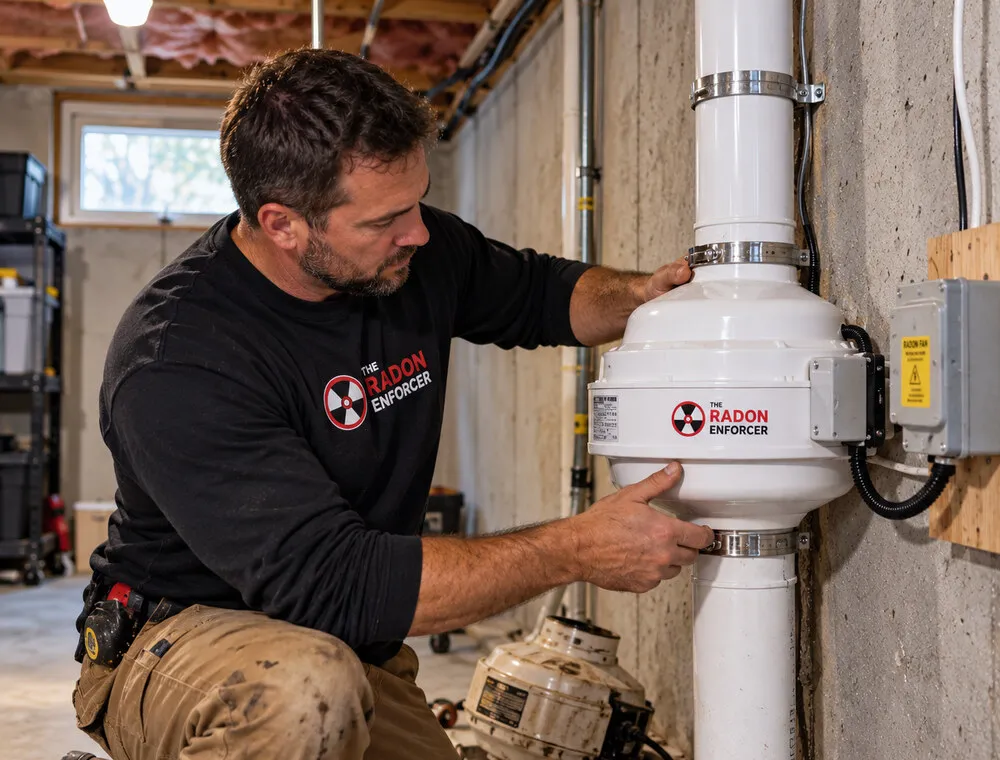
Signs Your Radon Fan Has Quit
A radon system doesn’t have a warning bell. It fails quietly, and the house goes right back to letting radon in. Here’s what homeowners usually notice first:
- The gauge on the pipe reads level. Both sides of the colored liquid are even. That means no suction.
- The fan is silent. You used to hear a low hum near the pipe and now you don’t.
- The fan got loud. Rattling, grinding, or a new buzz that carries through the pipe into the house.
- The pipe vibrates against the siding or the framing.
- Your monitor’s average crept back up after years of low numbers.
- The breaker or outdoor switch for the fan got flipped during other work.
Fan sound alone isn’t a reliable check. A fan can still spin while doing far less than it should. The gauge and a radon test are what tell you the truth.
How to Read the Gauge on Your Radon Pipe
That little U-shaped tube with red or blue liquid is a manometer. It shows suction in the pipe, not the radon level in your house.
- Liquid uneven (one side higher): the fan is pulling. Good.
- Liquid level on both sides: the fan isn’t pulling. Something is wrong.
- The number on the scale is pressure, not pCi/L. A reading that’s a bit higher or lower than last year isn’t a problem by itself. A big change from where it has sat for years is worth a call.
Whoever installed your system should have marked where the liquid sat on day one. If there’s no mark, snap a photo of it today so you have something to compare against.
What Else Breaks Besides the Fan
Not every flat gauge means a dead fan. We check all of these on a repair visit:
- Power. A tripped breaker, a switched-off outdoor disconnect, or a GFCI outlet that popped.
- The sump lid. Plumbers replacing a sump pump often pull the lid and leave it loose. You’ll sometimes hear air hissing around it.
- Pipe joints. A separated fitting in the attic or on the outside wall leaks suction.
- Crawlspace membranes. HVAC techs, plumbers, and pest control crews all work in crawlspaces, and a torn or loose membrane lets soil gas bypass the system.
- The rubber couplings that hold the fan to the pipe crack with age and weather.
Why a Bigger Fan Isn’t Always Better
When a system underperforms, the tempting fix is the biggest fan on the shelf. Sometimes that’s right. Often it isn’t. Fans are sized for how easily air moves under your slab. Tight soil needs a fan that pulls hard, while loose gravel needs a fan that moves a lot of air. The wrong fan can be louder, use more power, and pull conditioned air out of your basement without lowering radon any further.
We match the replacement fan to what the system actually needs, then check the gauge and retest.
When a Replacement Isn’t Enough
Sometimes the fan is fine and the system was never going to work. The usual culprits:
- One suction point trying to cover a basement, a slab addition, and a crawlspace
- A pipe route with so many bends the fan can’t keep up
- A fan mounted inside the living space, or a discharge near a window
- A renovation that changed the house after the system went in
In those cases we’ll explain what’s wrong and quote the fix. That might be a second suction point, a membrane, or a rerouted pipe, which is the same work as a new radon mitigation system on a smaller scale.
Quick Checks You Can Do Before You Call
- Look at the gauge on the pipe and take a photo of it.
- Check the breaker and any outdoor switch near the fan.
- Listen at the pipe for the fan’s hum.
- Look at the sump lid for gaps or a missing seal.
Don’t cut into the pipe, swap the fan yourself, or turn the fan’s speed down because it’s loud. If the gauge still reads level after the easy checks, get in touch. We fix radon systems all over York County, and a follow-up radon test confirms the repair worked.
Related radon services
Radon fan questions
How long does a radon fan last?
Radon fans run nonstop, so they do wear out eventually. Many last for years, but bearings, weather, and moisture in the pipe all take a toll. The gauge on the pipe is how you'll know when one quits, since the fan usually fails quietly.
Can you replace a fan on a system another company installed?
Yes. We work on systems put in by other companies, including companies that are no longer around. We check the whole system while we're there, not just the fan.
The plumber replaced our sump pump and now the gauge looks different. Why?
The sump lid was probably opened and not resealed airtight. That lets the fan pull basement air through the pit instead of soil gas from under the slab. We reseal or replace the lid so you can still reach the pump.
Is it safe to turn the radon fan off for a while?
The system only works while the fan is running, so it should stay on all the time. If you have to cut power for electrical work, turn it back on as soon as you're done and check the gauge.
Should we retest after a fan replacement?
Yes. A new fan should bring the system back to where it was, and a follow-up radon test proves it. It also catches cases where something else changed, like a new addition or a torn crawlspace membrane.
Gauge gone flat? We'll get it pulling again.
Tell Us What Your Radon Fan Is Doing
david@theradonenforcer.comFree Same-Day Estimate- You deal with the owner, David Brockelhurst
- Free same-day estimates, Monday to Saturday
- A follow-up radon test after every system
- Based in Red Lion, working all of York County