Radon Mitigation in York, PA
York has been building houses since 1741, and nearly every era of them is still standing. This is our complete guide to radon in the city: the houses, the history under them, what your number means, and how we fix it.
Quick answer: Yes, York homes can have high radon, from 1880s rowhouses to newer houses at the edge of the city. About 40% of Pennsylvania homes tested come in above the EPA’s 4.0 pCi/L action level, and the only way to know about your house is to test it. If your result is 4.0 or higher, a radon mitigation system, sized to your foundation and verified with a follow-up test, is the standard fix.
What’s on This Page
- York, PA at a glance
- Why radon is a York question, not just a Pennsylvania one
- A city built over 280 years
- York’s historic districts and what sits under them
- The York rowhouse
- Water, the Codorus, and your basement
- Renting in York: tenants and landlords
- Buying or selling a home in York
- How we fix radon in York homes
- What your radon number means
- York radon myths we hear
- York radon resource directory
York, PA at a Glance
| Fact | York, PA |
|---|---|
| County | York County (York is the county seat) |
| Founded | 1741; borough in 1787; city in 1887 |
| Population | 44,800 (2020 Census) |
| Area | About 5.3 square miles |
| ZIP codes | 17401, 17403, 17404, 17405 |
| National Register historic districts | York, Northwest York, Fairmount, and Springdale |
| Owner-occupied homes | 43.7% (Census, 2020 to 2024) |
| Median owner-occupied home value | $119,700 (Census, 2020 to 2024) |
| Runs through downtown | Codorus Creek |
| EPA radon action level | 4.0 pCi/L |
Those numbers already tell you a lot about radon work here. York is old, dense, and full of attached houses. More than half of its homes are rented. And a creek runs through the middle of town, which shapes how a lot of York basements handle water. Each of those things changes how a radon job goes, and this page walks through all of them.
Why Radon Is a York Question, Not Just a Pennsylvania One
Radon is a radioactive gas that comes from uranium breaking down in soil and rock. It moves up through the ground, and a house sitting on that ground pulls it in through the foundation. You can’t see it, smell it, or taste it.
Here’s what the agencies that track it say:
- About 40% of homes tested in Pennsylvania have radon levels above the EPA’s action guideline of 4 picocuries per liter, according to the Pennsylvania Department of Environmental Protection.
- The U.S. EPA estimates radon is responsible for about 21,000 lung cancer deaths a year in the United States.
- Radon is the leading cause of lung cancer among people who have never smoked, and the second leading cause overall.
- At 4 pCi/L, the EPA estimates about 7 in 1,000 people who never smoked could get lung cancer from a lifetime of exposure. For smokers, the figure is about 62 in 1,000. Radon and smoking together are far worse than either one alone.
- The average indoor radon level in the U.S. is about 1.3 pCi/L. Outdoors, it’s about 0.4 pCi/L.
Pennsylvania learned about indoor radon the hard way. In December 1984, a worker named Stanley Watras kept setting off radiation alarms at the Limerick nuclear plant, which was still under construction in eastern Pennsylvania. The contamination wasn’t coming from the plant. It was coming from his house, which sat on a geologic formation called the Reading Prong. His case pushed Pennsylvania and New Jersey to start testing homes on a large scale, and it’s a big part of why Pennsylvania has one of the country’s most developed radon programs today.
York isn’t on the Reading Prong. That doesn’t make York houses safe. The 40% figure is statewide, and radon levels swing house to house, even on the same block. Two rowhouses sharing a wall can test differently. That’s why every job we do starts with a real result from your house, not a guess based on a map.
A City Built Over 280 Years
To understand radon in York, it helps to understand how the city was built, because every era left behind houses with different foundations.
The colonial town (1740s to 1780s). York was laid out in 1741, and a few buildings from its first decade still stand. The Golden Plough Tavern, built in 1741 on West Market Street, is one of the rarest buildings in the state: a Germanic mix of log construction on the ground floor and half-timbering above, with brick and wattle-and-daub filling the frame. Next door, the General Horatio Gates House dates to 1751. Both are now part of the museum run by the York County History Center.
A capital for nine months (1777 to 1778). When the British took Philadelphia, the Continental Congress moved to York and met here from September 30, 1777, to June 27, 1778. While in York, Congress drafted and adopted the Articles of Confederation, the first legal document to refer to the colonies as “the United States of America.” The 1754 courthouse where they met was torn down in 1841. The replica in the Colonial Complex on West Market Street was built in 1976. That’s where York’s “first capital” claim comes from, though historians count it as the fourth city to host Congress.
The industrial city (1800s to 1940s). York became a borough in 1787 and a city in 1887. The rail lines and factories that grew up in between built most of the housing still standing downtown: long rows of brick houses for working families, larger Victorian homes for the people who owned the factories, and churches, halls, and markets to serve them all. York Central Market opened in 1888. Pfaltzgraff built its first pottery factory in the city in 1895 and made pottery in York until 2005. The York Peppermint Pattie was created here in 1940.
The York Plan (1940s). During World War II, York’s manufacturers pooled their machines and skilled workers so that small shops could share big defense contracts. The approach, known as the York Plan, surveyed 245 plants in the area and became a model the federal government pointed other cities to. Its motto was “Do what you CAN with what you HAVE.”
The postwar city and the suburbs (1950s on). After the war, much of the new building moved outward into the surrounding townships: ranches, split-levels, and later subdivisions with poured basements. That’s the housing we write about on our Springettsbury Township and West Manchester Township pages.
What this means for radon: a York radon system might be going into a 250-year-old stone cellar, a 130-year-old brick rowhouse, a Queen Anne with a basement that’s been remodeled three times, or a 1990s poured basement five minutes away. The approach changes with each one.
York’s Historic Districts and What Sits Under Them
York has four historic districts on the National Register of Historic Places. They’re a good map of where the city’s oldest foundations are.
York Historic District
The heart of downtown. First listed in 1979 and expanded in 2008, it covers about 723 acres and more than 300 contributing buildings, roughly bounded by the railroad tracks, Hartley Street, Lilac Lane, and Codorus Creek. Its buildings run from St. John’s Episcopal Church (1765) and the Friends Meeting House (1766 to 1783) through Christ Lutheran Church (1812 to 1814), Odd Fellows Hall (1850), and the Strand and Capitol theatres (1923 to 1925). Late Victorian, Classical Revival, and Dutch Revival styles are all here.
For radon, downtown homes are mostly old masonry and brick with stone or brick foundations. Basements tend to be tight and often hold decades of changes: a concrete floor poured over what was once dirt, a coal bin turned into storage, pipes cut through the walls wherever they were needed.
Northwest York Historic District
A residential neighborhood listed in 1983, with 815 contributing buildings developed between 1882 and 1930. It’s roughly bounded by Carlisle, Texas, Pennsylvania, Newberry, Park, and Linden avenues. The houses are late Victorian, Colonial Revival, and American Foursquare.
Foursquares and larger Victorians usually have full basements under the whole footprint. That’s good news for radon work, because a full basement often lets one well-placed suction point reach a lot of slab. The catch is usually a back addition, a sunroom, or an enclosed porch on its own slab or crawlspace, which the main suction point may not reach.
Fairmount Historic District
Listed in 1999, with 101 contributing buildings built between 1889 and about 1915 in the Queen Anne and Second Empire styles. It’s roughly bounded by Cherry Lane, Stevens Avenue, and Cottage Hill Road.
Queen Annes are famous for irregular footprints: towers, bays, wraparound porches. Underneath, that can mean a basement that doesn’t follow the walls above, with crawlspace pockets under bays and porches that were later enclosed. We map the whole footprint before we quote.
Springdale Historic District
York’s fourth National Register district, a residential neighborhood. Its homes get the same careful look at foundations, additions, and basement changes as the rest of the older city.
Neighborhoods beyond the districts
York is made up of many neighborhoods, and radon doesn’t stop at a district line. Old Towne East, bounded by Market, Queen, Prospect, and Broad streets, is built largely of working-class rowhouses from about a century ago, and in 2004 it became the first neighborhood in Pennsylvania named an Elm Street community. Salem Square on the west side takes its name from the old road that ran from York to New Salem. Wherever you live in the city, the test on your house is the number that counts.
The York Rowhouse
If there’s one house that says “York,” it’s the brick rowhouse. Rows of attached brick homes line block after block of the older city, and twins, two homes sharing one wall, are common too. They’re solid houses. They also raise radon questions that detached-house guides never cover.
Your house, your test
Each rowhouse sits on its own slice of ground with its own basement floor. Radon comes up through that floor, the joint where the floor meets the walls, the sump if there is one, and every pipe opening. Your neighbor’s radon result, good or bad, tells you nothing reliable about yours, and your neighbor’s radon system is designed to lower the level in their house. Test your own home.
What’s usually in a York rowhouse basement
- A narrow footprint, often long and deep but only one room wide
- Low ceilings, sometimes well under seven feet
- Brick or stone foundation walls, with party walls shared with the houses on either side
- A concrete floor added later, sometimes thin, sometimes over old dirt
- A crowded utility corner with the furnace, water heater, and electric panel
- Old openings: abandoned drains, coal chute doors, and pipe holes from a century of upgrades
How a rowhouse radon system usually goes
- Suction point placement. We pick a spot where air can move under the floor and where the pipe won’t block a doorway or the furnace. In a long, narrow basement, we check how far suction reaches toward the front of the house.
- Sealing. Big openings in old walls and floors get sealed so the fan pulls soil gas, not basement air. On shared walls, we seal the openings on our side and note anything that crosses into the neighbor’s space.
- The route out. On most rowhouses, the pipe goes up the back of the house or through an interior closet or chase. Almost never up the front.
- The discharge. The pipe has to end above the roof edge and away from windows and openings. On attached homes, that includes the neighbors’ windows. We look at both sides before we pick a route.
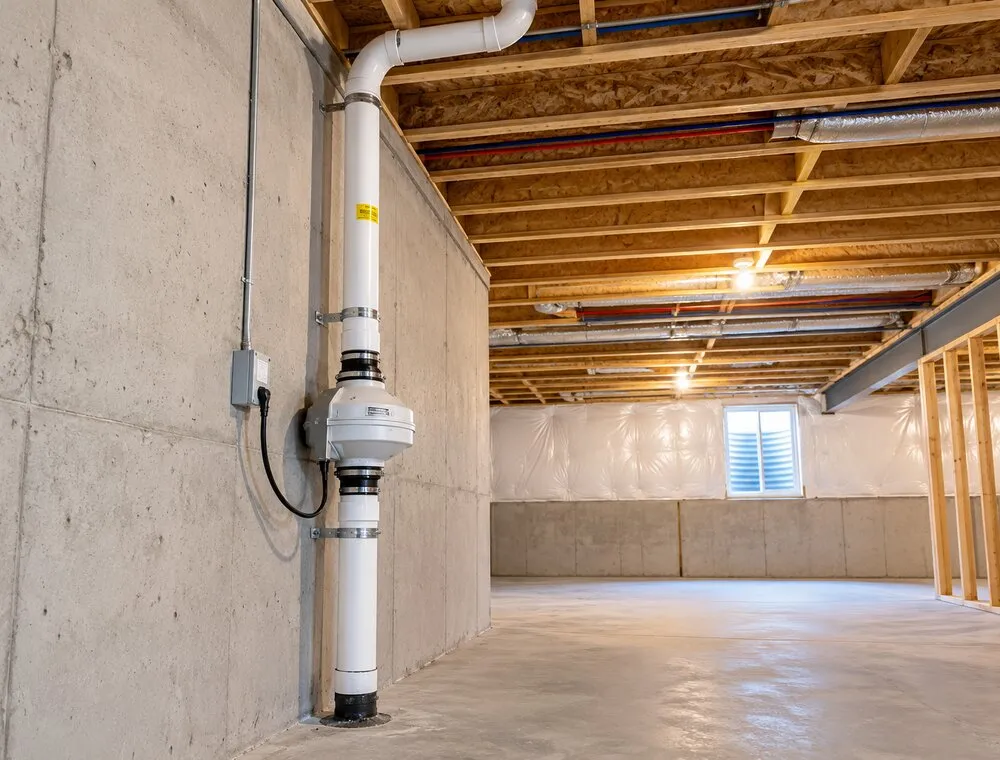
- The fan. It mounts outside the living space, on the exterior or in an unconditioned attic, never in the basement or a living area. EPA guidance says the fan must not be located in or below a livable area.
- The test. A follow-up test once the system has been running, so you have a before-and-after number.
Water, the Codorus, and Your Basement
Codorus Creek runs right through downtown York, and it has shaped the city in ways most people don’t connect to radon.
In 1933, a flood on the Codorus did about $4 million in damage in York, worth roughly $75 million today. More than 800 properties were lost and about 3,000 people were left homeless. That flood led the U.S. Army Corps of Engineers to build Indian Rock Dam upstream, finished in 1942. During Tropical Storm Agnes in 1972, the dam held back 9.1 billion gallons of water. The Corps estimates downtown York could have flooded up to 13 feet higher without it.
Why bring that up on a radon page? Because a city that’s fought water for a century is a city full of basements built to move water. That usually means:
- Sump pits that open straight down to the soil and drain tile under the house
- Interior drain channels along the base of the walls
- Floor drains that connect to old lines
- Waterproofing work added over the years, some of it over older repairs
Every one of those is also a path for soil gas. An open sump is often the biggest radon entry point in a basement. The good news is that the same features can help a radon system. A sump sealed with an airtight lid stops breathing soil gas into the house, and in some homes the drain tile around the foundation can carry suction along the walls. We check all of it on the first visit.
One more thing York homeowners run into: a plumber replaces the sump pump, pulls the radon lid, and doesn’t reseal it. If your basement has a radon system and the pump was recently replaced, check the lid and the gauge on the pipe. If the lid is loose or the gauge reads level, that’s a radon fan replacement and repair call, not a new system.
Renting in York: Tenants and Landlords
York is a city of renters. Census figures put the owner-occupied rate at 43.7%, which means most homes in the city are rented. That changes the radon conversation, because the person breathing the air often isn’t the person who owns the house.
If you rent
- You can test. A short-term test is simple, and it doesn’t damage anything. The American Lung Association, working with the Pennsylvania Department of Environmental Protection, offers free test kits to Pennsylvania residents, one per household, delivered in two to four weeks.
- Test the lowest level you live on. If your bedroom is in the basement or your unit is on the ground floor, that’s where the test goes.
- Share a high result in writing. If you get 4.0 pCi/L or higher, send your landlord the result and a link to the EPA’s radon guidance. Keep a copy.
If you own rentals
Pennsylvania isn’t one of the handful of states that require landlords to disclose radon to tenants. There are still good reasons to test:
- A test is inexpensive and easy to document.
- A known result, fixed and verified, is a clean record if a tenant ever asks.
- A high result found before you sell is easier to handle than one found by a buyer’s inspector.
- For buildings with several units, there’s a national testing standard written specifically for multifamily buildings (ANSI/AARST MAMF), which spells out how to test units in the same building.
We can work with York landlords on single rowhouses and small multi-unit buildings, schedule around tenants, explain the system to them in plain English, and give you the post-mitigation test results for your records.
Buying or Selling a Home in York
For most York homeowners, radon comes up for the first time during a sale. The buyer’s inspector sets a short-term test, and the result lands in the middle of a tight contract timeline.
If you’re selling:
- Pennsylvania’s Real Estate Seller Disclosure Law (68 Pa.C.S. §§ 7301 to 7315) requires sellers to fill out a disclosure statement about the property, and the standard form asks about radon. If you’ve tested, or have a system, you’ll be asked about it.
- Testing before you list lets you fix a high number on your schedule and hand buyers a passing post-mitigation result.
- If there’s already a system, check that the fan is running and the gauge shows suction. A dead fan found during inspection makes a buyer nervous.
If you’re buying:
- Ask for the full test report, not just the number.
- If a system is going in before closing, ask for the post-mitigation result in writing.
- If the house already has a system, find the fan, find the gauge, and learn what “normal” looks like on it. After closing, it’s yours.
If the clock is running: tell us your closing date in your first message. We set up estimates the same day you reach us during business hours, and we’ll be straight about how the install and the follow-up test fit your timeline. Our radon testing page explains how sale tests work.
How We Fix Radon in York Homes
Almost every York home gets the same method: active soil depressurization, often called sub-slab depressurization. According to the EPA, sub-slab suction typically cuts radon levels by 50 to 99 percent. The difference between the low and high end of that range comes down to how well the system fits the house.
Here’s how we approach a York job:
- Walk the whole house. Main basement, any crawlspace, slab additions, enclosed porches, the sump, floor drains, and the condition of the walls.
- Figure out how air moves under the floor. On older York basements with patched or layered floors, we check how far suction will actually reach before we promise a result.
- Plan the route with you. Where the suction point goes, where the pipe runs, where the fan mounts, and where it discharges. You see the plan before we drill.
- Install and seal. Suction point, sealed PVC pipe, a fan outside the living space, an airtight sump lid if you have a sump, and sealing at the major openings.
- Add a gauge you can read. The EPA requires a warning device on active systems. Ours is a U-tube manometer on the pipe. If both sides of the liquid ever read level, the fan has stopped pulling.
- Test again. The EPA says to run the follow-up test no sooner than 24 hours after the system starts and within 30 days of installation. You get the result.
The EPA is clear that sealing cracks alone hasn’t been shown to lower radon significantly or consistently. Sealing supports a system. It isn’t a substitute for one.
For the full details on system design, crawlspaces, and finished basements, see our radon mitigation page. For the rest of the county, start on our York County radon mitigation home page.
What Your Radon Number Means
| Your result | What EPA guidance means for your York home |
|---|---|
| Below 2 pCi/L | Low. Retest after major changes to the house or every few years |
| 2 to 3.9 pCi/L | Below the action level. The EPA suggests considering a fix |
| 4.0 pCi/L and up | Fix the home. A mitigation system is the standard repair |
A few things to keep in mind:
- There’s no known safe level. The EPA’s 4.0 is a line for action, not a line where the risk starts.
- A 4.2 isn’t an emergency, and a 20 isn’t a reason to move out tonight. Radon risk comes from years of breathing it. Both numbers mean the same thing: get a system in and test again.
- Short-term tests run 2 to 90 days. Long-term tests run more than 90 days and give a better picture of your year-round average.
- Retest every two years after a system goes in, and after any major renovation of the lowest level.
York Radon Myths We Hear
“Old houses breathe, so radon just leaks back out.” Drafty houses can still test high. The Pennsylvania DEP says radon shows up in new and old homes, drafty and tight ones, with and without basements.
“My rowhouse is attached, so I’m covered by the neighbors’ system.” Their system is designed for their house. Test yours.
“My basement is only for storage, so it doesn’t matter.” Radon doesn’t stay in the basement. Air moves up through the house, and the lowest level you live on is where the test belongs.
“A dehumidifier or air purifier will take care of it.” Neither stops soil gas coming in through the foundation. A mitigation system does.
“York’s not on the Reading Prong, so we don’t have a radon problem.” About 40% of Pennsylvania homes tested are above the action level. The map doesn’t test your house. A test does.
“If there’s a pipe on the house, it’s fixed.” Only if the fan is running. Check the gauge. If the liquid is level on both sides, the system isn’t working.
York Radon Resource Directory
These are the official and nonprofit sources we trust and point York homeowners to. We have no connection to any of them.
| Resource | What it’s for |
|---|---|
| Pennsylvania DEP Radon Division | The state radon program. Radon Hotline: 800-237-2366. Homeowner questions, radon information, and the state’s radon services directory |
| PA DEP: Radon in the Home | Pennsylvania’s guide to radon in houses, testing, and retesting |
| U.S. EPA Radon | Federal radon guidance, including the 4.0 pCi/L action level |
| EPA: Health Risk of Radon | The EPA’s risk estimates for smokers and people who never smoked |
| EPA Consumer’s Guide to Radon Reduction | How mitigation works and what to expect from a system |
| American Lung Association free radon test kits for Pennsylvania | Free short-term test kits for Pennsylvania residents, one per household |
| EPA: A Citizen’s Guide to Radon | The EPA’s plain-language guide for households: testing, results, and next steps |
| EPA: A Radon Guide for Tenants (PDF) | Written for renters: how to test, and how to talk with a landlord about the result |
| EPA: Radon Resources for the Real Estate Community | The EPA’s radon guides for buyers, sellers, and agents |
| York County History Center | York’s history, including the Golden Plough Tavern, Gates House, and Colonial Complex |
York Is Where Our County Starts
York is the center of the county we serve, and it’s about 8 miles from our shop in Red Lion. Whether your house is a Northwest York Foursquare, a rowhouse in Old Towne East, a Queen Anne in Fairmount, or a rental you own on the west side, the steps are the same: find out your number, build a system that fits the house, and prove it worked with a follow-up test.
When you’re ready, you’ll deal with the owner, David Brockelhurst, and you’ll get a free estimate set up the same day you reach us during business hours. Read about radon testing if you haven’t tested yet, radon mitigation if your number is high, or radon fan replacement if you already have a system that isn’t pulling. For every town we cover, see our service area page.
Radon services in York
York radon questions
Do York rowhouses need their own radon test if the house next door already has a system?
Yes. Each house in a row sits on its own section of slab and soil, and your neighbor's system is built to lower the level in their house, not yours. The only number that tells you about your home is a test taken in your home.
Can a radon system go on a narrow York rowhouse without running up the front?
Usually, yes. Most rowhouse systems run up the back wall or through an interior chase to the roof. The discharge has to end above the roof edge and away from windows and openings, including the neighbors', so we plan the route before any drilling starts.
I rent in York. Can I test for radon myself?
Yes. A short-term test kit is simple to use, and the American Lung Association offers free kits to Pennsylvania residents, one per household. If the result is 4.0 pCi/L or higher, share it with your landlord in writing and point them to the EPA's guidance.
Do Pennsylvania landlords have to test for radon or tell tenants about it?
Pennsylvania isn't one of the few states with a specific radon disclosure rule for landlords. Testing is still a smart move, especially for units with living space on the lowest level, because it's inexpensive and easy to document.
My York home has a sump pump because the basement used to take on water. Does that matter for radon?
It matters a lot. An open or loosely covered sump pit connects your basement air directly to the soil and drain tile under the house. A radon system seals the pit with an airtight lid that still lets you service the pump, and sometimes uses the drain tile to spread suction around the foundation.
How soon after a system goes in should the house be tested again?
The EPA says to run the follow-up test no sooner than 24 hours after the system starts running and within 30 days of installation. We do a follow-up test on every system we install.
How fast can you get to a home in the city?
We're based in Red Lion, about 8 miles southeast of York. Estimates are free, and we set them up the same day you reach us during business hours, Monday through Saturday.
Ready to get it handled?
Get a Straight Answer About Your York Radon Number
david@theradonenforcer.comFree Same-Day Estimate- You deal with the owner, David Brockelhurst
- Free same-day estimates, Monday to Saturday
- A follow-up radon test after every system
- Based in Red Lion, working all of York County