Radon Mitigation System Installation
Your test came back high. Here is how we bring the number down, what the system looks like on your house, and how you'll know it worked.
You Failed the Radon Test. Here’s What Happens Next.
Most people find out about radon the same way. The home inspector’s test comes back at 6.8, or 11, or 4.3, and suddenly the realtor wants it handled before closing. Or you bought a monitor, the number kept climbing, and now you’re staring at a basement you’ve been sleeping in.
Here’s the short version. A reading at or above 4.0 pCi/L means the EPA recommends fixing the house. The fix is a radon mitigation system, and it works on nearly every house in York County. The rest of this page explains what we install, what we check first, and how you’ll know it worked.
How a Radon Mitigation System Works
Radon comes from uranium breaking down in the soil and rock under your house. It moves up as a gas and slips in through the easiest path: the joint where the floor meets the wall, cracks in the slab, the sump pit, gaps around pipes.
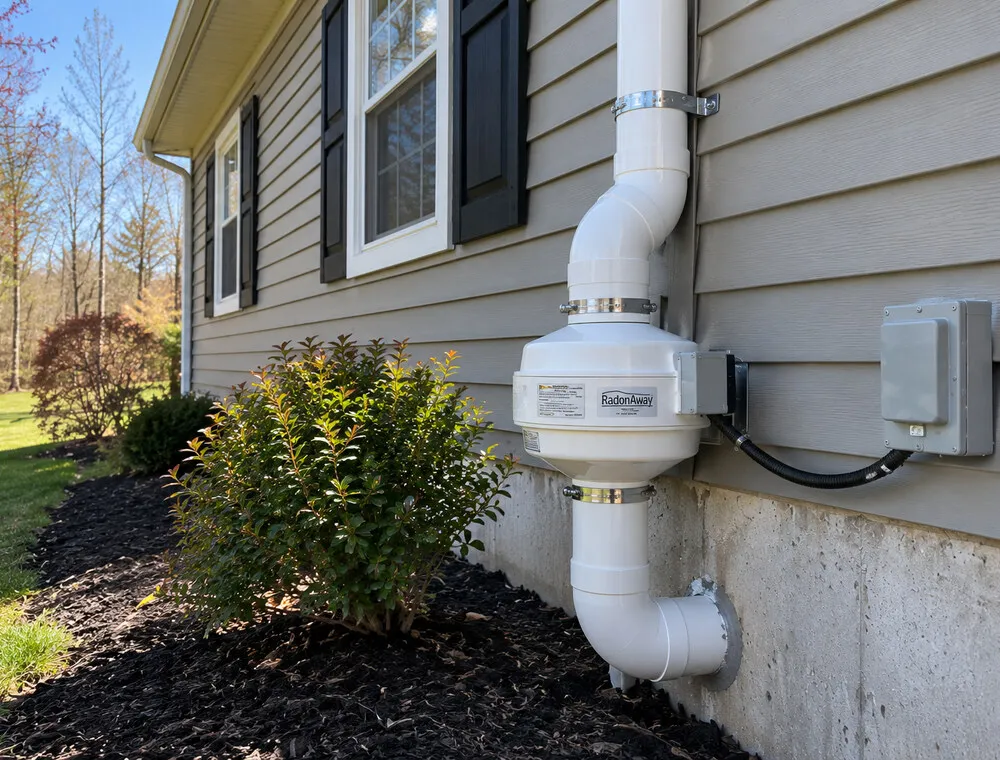
A mitigation system flips that pressure. The method is called active soil depressurization, and it has four parts:
- A suction point. We core a hole through the basement slab and dig out a small pit underneath so air can move.
- Sealed PVC pipe running from that pit up and out of the house.
- A radon fan mounted outside the living space, usually on the exterior wall or in the attic or garage. It runs all the time and pulls soil gas out from under the slab before it can get inside.
- A discharge above the roof edge and away from windows, where the gas mixes into outside air.
We also seal the openings that would let the fan pull house air instead of soil gas, like the sump pit and the bigger cracks. A small U-tube gauge, called a manometer, goes on the pipe so you can see at a glance that the system is pulling.
Matching the System to Your Foundation
York County houses rarely come in one simple shape. This is where a good system and a bad one part ways.
| What’s under your house | What usually works |
|---|---|
| Poured concrete basement | Sub-slab suction, often one well-placed point |
| Block basement | Sub-slab suction, plus attention to the hollow block walls |
| Old stone basement | Sub-slab suction with extra sealing at wall joints and any dirt areas |
| Dirt or gravel crawlspace | A sealed plastic membrane over the soil with suction under it (sub-membrane) |
| Basement plus crawlspace addition | Two suction areas tied into one system, or two systems |
| Split-level | Suction under each slab the pressure field can’t reach on its own |
The mistake we see most is one suction point drilled into the basement of a house that also has a slab addition and a crawlspace. The basement comes down. The rest of the house doesn’t.
What We Check Before We Quote
Before we give you a price, we walk the whole house.
- Every foundation area. Basement, slab, crawlspace, garage, and any addition, and where they connect.
- The sump and drain tile. An open pit is a big leak. Drain tile around the footing can sometimes carry suction the whole way around.
- How air moves under the slab. On bigger or trickier slabs we do a communication test: suction at one spot, readings at another. It tells us how far one suction point will actually reach.
- The pipe route. Inside through a closet or utility room, or up the outside wall. We plan it with you.
- Power for the fan. The fan needs a dedicated, always-on circuit or outlet near where it mounts.
Finished Basements
If your lowest level is a family room, a bedroom, or a home office, it’s also the room where radon matters most, since you’re spending hours there every day. It’s also where people worry we’ll tear things up.
We look for the least visible path first: an unfinished utility corner, a storage closet, a furnace room. The suction point often goes in an unfinished area, and the pipe follows the walls you’d least notice. You’ll see the plan before we cut anything.
What Affects the Price
We don’t post a flat price, because the house decides the job. These are the things that move it:
- How many separate foundation areas need suction
- Whether there’s a crawlspace, and how big it is
- How freely air moves under the slab
- How long and how hidden the pipe route needs to be
- Whether the sump needs a sealed lid
- Where the fan can mount and how far power is from there
The estimate is free, and we can usually set it up the same day you reach us during business hours.
After the Install
Once the fan has been running for at least a day, a follow-up radon test shows what the system did. You keep that result. If you’re selling, your buyer will want it.
After that, glance at the gauge on the pipe now and then. If both sides of the liquid are level, the fan has stopped, and that’s a radon fan replacement call. The EPA also recommends retesting every two years, and after any big renovation. If you’re still deciding whether you need a system at all, start with radon testing.
Related radon services
Radon mitigation questions
How long does a radon mitigation install take?
A straightforward basement system is usually a single visit. Houses with more than one foundation type, a crawlspace that needs a membrane, or a long pipe route in a finished basement can take longer. We'll tell you what to expect when we quote the job.
Where does the pipe go, and will I see it?
The pipe runs from a sealed hole in the slab up and out of the house, with the fan outside the living space and the discharge above the roof edge, away from windows. On many houses we can run it through a closet, a utility room, or the garage so it isn't on the front of the house. We'll show you the options before we drill.
Does a radon system use a lot of electricity?
A radon fan is a small inline fan that runs all the time. It uses about as much power as a light fixture or two, depending on the model. It has to run continuously to keep working, so never switch it off.
Will the system work if we have a sump pump?
Yes. An open sump pit is a common radon entry point, so we seal it with an airtight lid that still lets you get to the pump. Some systems actually draw through the sump and the drain tile around the foundation.
What if the number is still high after the system goes in?
That's why we test again. If the follow-up result is still at or above 4.0 pCi/L, we look at why, whether it's a second foundation area the suction isn't reaching or airflow under the slab, and we adjust the system.
High radon result in hand? Send it to us.
- You deal with the owner, David Brockelhurst
- Free same-day estimates, Monday to Saturday
- A follow-up radon test after every system
- Based in Red Lion, working all of York County