
Radon Mitigation in Wrightsville, PA
Wrightsville climbs up from the Susquehanna River across from Columbia. Hillside lots mean walkout basements, and walkouts fool a lot of people about radon.
A River Town Built on a Slope
Wrightsville sits on the west bank of the Susquehanna River, the York County side, with Columbia across the water in Lancaster County. US Route 30 and PA Route 462 both cross the river here, and the town has a real place in Civil War history: in June 1863, the bridge to Columbia was burned to keep Confederate troops from crossing.
The town climbs uphill from the river, and so do the houses. Hellam Township, next door, has some of the oldest construction in the county, including early stone houses with raised stone walkout basements. That slope shapes a lot of radon work around here.
Walkout Basements Still Need Testing
A lot of people assume this: “Our basement has a door and windows, it’s practically above ground. Radon can’t be a problem.” It can.
A walkout basement on a hillside is still built into the soil. Look at it from the side:
- The uphill wall is fully buried against the hill.
- The side walls are partly buried, stepping down the slope.
- The slab sits on soil across the whole footprint.
- Only the downhill wall is open to the air.
Radon comes through the slab, the buried walls, and the joints between them, just like any basement. And a hillside can hold a lot of soil against the back wall. A walkout isn’t protected because one side has a door.
Old Stone on the River Side
Older Wrightsville homes near the river often have masonry or stone foundations, sometimes with later concrete floors and additions on the back. Those need the kind of work every old York County basement needs: sealing the stone joints and big openings so the fan pulls from under the floor, and checking for crawlspaces under back additions that a single suction point won’t reach.
Designing for a Slope
A hillside house changes a few things about radon mitigation:
- Suction point placement. We often favor a spot near the buried uphill side, where soil contact is greatest, and check how far suction reaches across the slab.
- Pipe route. The uphill side or a gable end is often less visible. Some houses have a good inside route through a utility room.
- Discharge height. The pipe has to end above the roof edge and away from windows, and on a slope the roofline on one side can be much higher than the other.
- Additions. A back addition on a slab or crawlspace is common and gets its own suction area when needed.
Get Started in Wrightsville
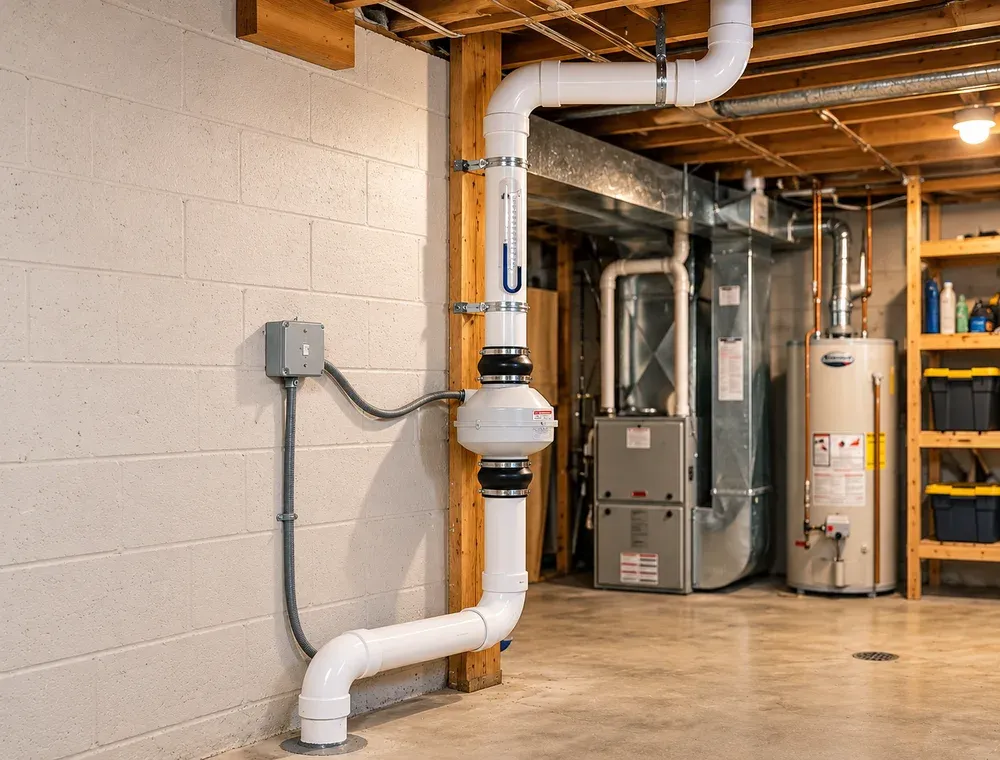
No number yet? Set up radon testing. Already have a system with a gauge reading level, or a fan making noise? That’s radon fan replacement. Wrightsville and Hellam are both part of our radon mitigation coverage in York County, with free estimates set up the same day you reach us during business hours.
Wrightsville radon questions
Half our basement is above ground. Do we still need to test?
Yes. A walkout still has a slab on soil and at least one wall buried against the hill. Radon comes through the slab, the buried wall, and the joint between them. Only a test tells you the level.
Where would the pipe go on a house built into a hill?
Often up the uphill side or the gable end, where it's less visible from the street, with the fan outside and the discharge above the roof edge. On some houses an inside route through a utility room works better. We plan it on site.
Ready to get it handled?
- You deal with the owner, David Brockelhurst
- Free same-day estimates, Monday to Saturday
- A follow-up radon test after every system
- Based in Red Lion, working all of York County