Radon Testing Before You Buy, Sell, or Finish a Basement
There's no way to see, smell, or guess a radon level. A test is the only way to know, and it's the first step before any system goes in.
Nobody Can Tell You Your Radon Level by Looking
Radon doesn’t care if a house is old or new, drafty or tight, with a basement or on a slab. The Pennsylvania Department of Environmental Protection says as much, and about 40% of Pennsylvania homes tested come in above the EPA’s action level. A test is the only way to know where yours sits.
That’s all radon testing is: a measurement, taken the right way, so you can make a decision. Most tests come back fine. When one doesn’t, you’ll have a real number to plan around, and a clear next step in radon mitigation.
Short-Term and Long-Term Tests
There are two kinds, and each has a job.
- Short-term tests run from 2 to 90 days. Home sales almost always use a short-term test, because nobody wants to wait three months to close.
- Long-term tests run more than 90 days. They give a better picture of your average level across seasons, which matters when you’re living in the house for years.
Either way, the house is kept closed during the test: windows shut, doors used only for normal coming and going. The test goes on the lowest level that’s lived in or could be, away from drafts, outside walls, and humid rooms like bathrooms and laundry areas.
Radon Testing for Home Sales
This is where most York County homeowners run into radon for the first time. The buyer’s inspector sets a test during the inspection window, the number comes back, and everybody wants to know what it means right now.
If you’re selling, testing before you list takes the surprise out of it. If the number is high, you can have a system in and a passing follow-up test before a buyer ever asks.
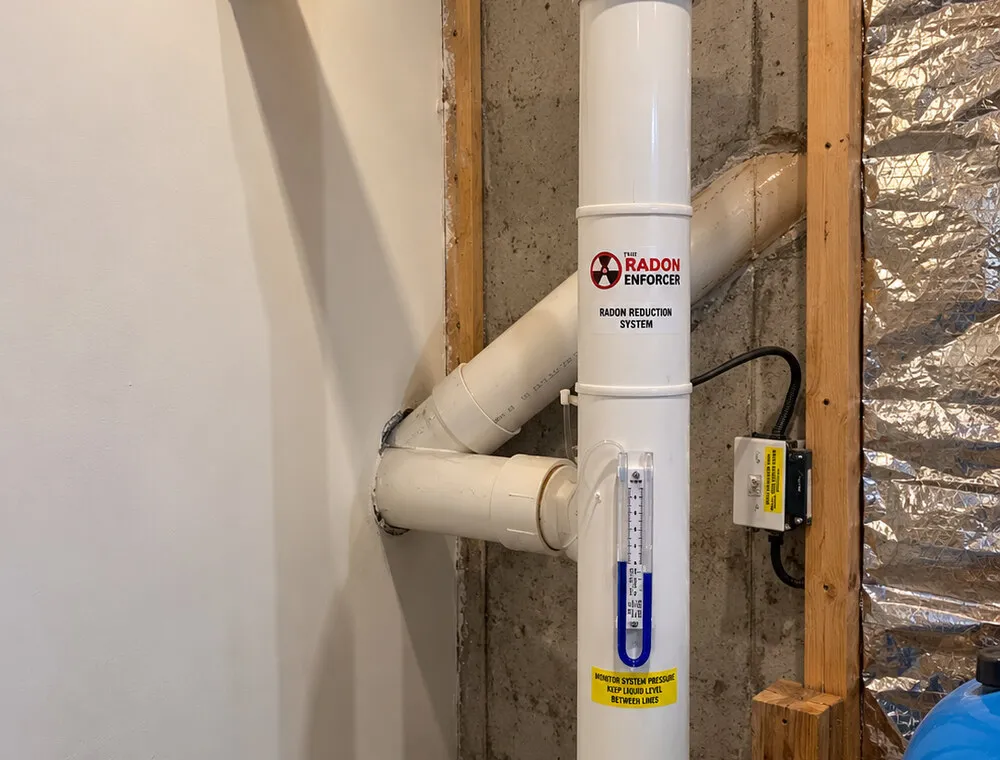
If you’re buying, ask for the result in writing and ask whether the house already has a system. A pipe on the side of the house doesn’t guarantee the fan is running. Look at the gauge on the pipe. If both sides of the liquid are level, that system isn’t pulling, and you’ll want the fan checked as part of the deal.
When to Test Your Own Home
- You’ve never tested, or you can’t remember the last time
- You’re about to finish the basement or turn it into a bedroom, office, or playroom
- You’ve added on, replaced the slab, or done big foundation or drainage work
- A neighbor or family member nearby tested high
- You had a system installed and it’s been two years since the last test
What Your Result Means
| Your result | What the EPA guidance means for you |
|---|---|
| Below 2 pCi/L | Low. Retest after big changes to the house or every few years |
| 2 to 3.9 pCi/L | Below the action level, but the EPA suggests considering a fix |
| 4.0 pCi/L or higher | Fix the house. A mitigation system is the standard repair |
A result of 4.2 is not an emergency, and a result of 20 isn’t a reason to move out tonight. Radon risk comes from years of breathing it. Both results mean the same thing: get a system in, then test again to prove it worked.
Testing After a System Goes In
Every system we install gets a follow-up test once the fan has been running at least a day. After that, retest every two years and any time you renovate the lowest level. If a later test comes back higher than the one after install, something changed, and it’s often the fan. That’s a radon fan replacement visit, not a whole new system. We do this work for homeowners all over York County, from the Maryland line up to Dillsburg.
Related radon services
Radon testing questions
Can a dehumidifier or air purifier lower my radon?
No. A dehumidifier pulls moisture out of the air, and radon isn't moisture. Air purifiers can catch some of the particles radon breaks down into, but they don't stop the gas coming in from the soil. The fix for a high number is a mitigation system.
Does opening the windows fix radon?
It can lower the reading while the windows are open, and it will also make your test invalid. Windows closed is how radon tests are supposed to be run. As a long-term plan, open windows aren't practical in a York County winter, which is when many homes run higher.
My continuous monitor jumps around every day. Is something wrong?
Probably not. Radon levels change with weather, soil moisture, and how the house is being heated or cooled. Look at the longer average, not a single day. If the average stays at or above 4.0 pCi/L, it's time to talk about a system.
My neighbor tested high. Does that mean I will too?
It means you should test. Houses right next to each other can have very different results because of what's under each one and how each is built. Your neighbor's number is a good reason to test, not an answer.
We have a private well. Should we test the water?
Start with the air. Soil gas is the main source of radon in homes. If the air test is high and the house is on a private well, testing the water separately can tell you whether the well is adding to it.
Buying or selling? Get the radon question answered early.
- You deal with the owner, David Brockelhurst
- Free same-day estimates, Monday to Saturday
- A follow-up radon test after every system
- Based in Red Lion, working all of York County